Originally published September 17, 2021 | Updated July 2025
By Pranaclimb | Love, Breathe, Climb

🧠 Rate of Perceived Exertion (RPE) & Breathing Rate (BR)
Respiratory frequency (fR)—also known as breathing rate (BR)—is strongly associated with perceived exertion (RPE) across various exercise modalities. For climbers, this relationship may be even more pronounced due to the physical and psychological complexity of climbing.
🧭 Perceived exertion is your subjective sense of effort, fatigue, or discomfort during movement. If you’ve used Strava or tracked workouts, you’ve already rated your RPE.
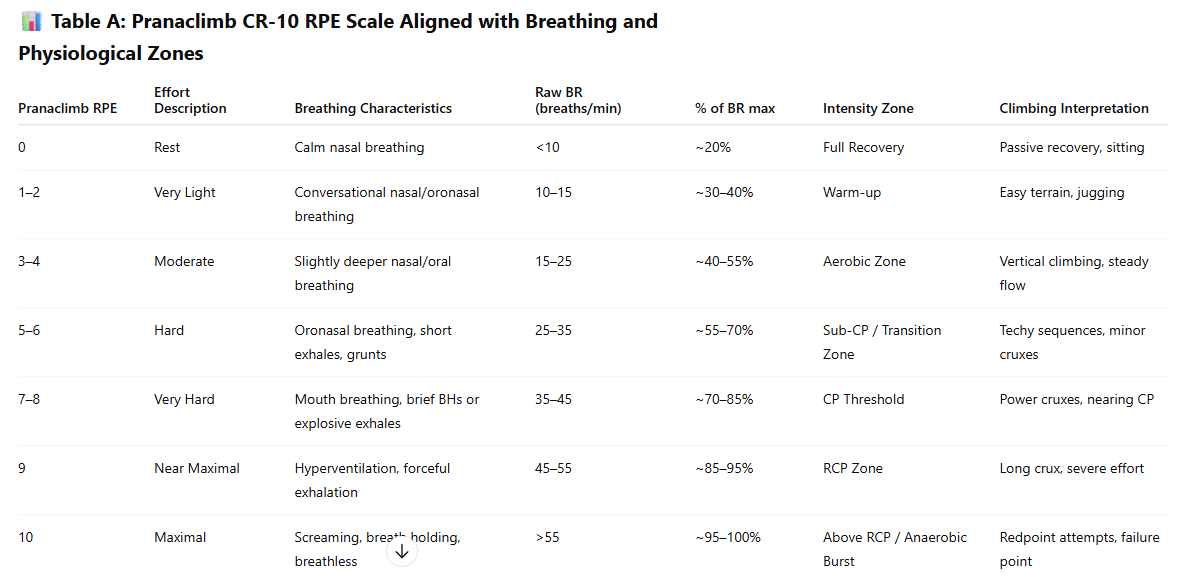
✅ Pranaclimb Threshold Reference:
CP (Critical Power) ≈ 45 BPM / ~80–85% BRmax / RPE 8
RCP (Respiratory Compensation Point) ≈ 55 BPM / ~95–100% BRmax / RPE 9–10
BRmax for elite climbers is estimated ~60–65 BPM during max effort
Data aligns with: Nicolò et al. (2017), Keir et al. (2018), and Pranaclimb case studies (Ondra, Hayes, Shannon)
🔬 What the Science Says
“Respiratory frequency (fR) is emerging as a valuable measurement for training monitoring... more information can be gained from fR than from heart rate, VO₂, or lactate. It is strongly associated with perceived exertion across many exercise types and conditions.”
— Nicolò et al., 2017 [1]
“fR—but not HR or VO₂—tracks RPE over time regardless of exercise duration.”
— Nicolò et al., 2016 [2]
In short: How fast you breathe may be the best non-invasive indicator of physical and mental effort.
🧗♂️ Breathing Patterns of Elite Climbers
Real-World Comparison: Adam Ondra vs. Štěpán Stráník on an 8b Route
A fascinating case study compared Adam Ondra and Štěpán Stráník climbing the same 8b route using Hexoskin biofeedback (BR, VE, HR). Pranaclimb estimated tidal volume (TV) to reveal the full respiratory story.
“The route was relatively easy for Adam (9c climber), but for most Czech climbers—including Štěpán—it represents near-max difficulty.”
— Boček et al., 2018 [3]
Note: Hexoskin doesn't take into account the nuances of breathing in climbing (e.g., grunts, breath holds, sighs, screams).
✅ Key Physiological Context:
-
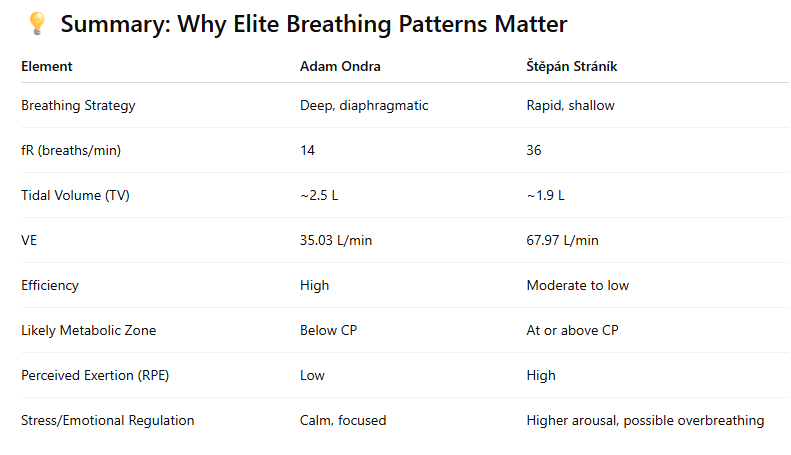
Adam Ondra
BR = 14 BPM
VE = 35.03 L/min
TV ≈ 2.5 L
➤ Interpretation: Below CP, breathing efficient, deep, relaxed. Very low internal load.
-
Štěpán Stráník
BR = 36 BPM
VE = 67.97 L/min
TV ≈ 1.9 L
➤ Important nuance: While this BR is elevated compared to Adam, it may still be just below or around CP for Štěpán, depending on his personal threshold. It reflects moderate-to-high effort, but not necessarily above CP.
Tidal Volume (TV) and Respiratory Fitness
Trained athletes increase TV before BR.
Near RCP, TV plateaus while BR spikes.
Adam’s high TV and low BR = aerobic efficiency.
Štěpán’s low TV and high BR = compensatory breathing under fatigue.
VE Inflection at Lactate Threshold (VT2)
Minute ventilation (VE) increases non-linearly at the lactate threshold.
This occurs at ~60–75% VO₂max in most people, but at around 80–85% in elite athletes.
Pranaclimb training (nasal breathing, CO₂ tolerance, pacing) helps delay this shift.
Energy Cost of Breathing
Rapid breathing increases dead-space ventilation—wasted energy not contributing to gas exchange.
Deep, controlled breaths reduce respiratory fatigue and optimise oxygen delivery to working muscles.
🧘♂️ Mental State & Breath Control
Adam’s relaxed BR reflects low psychological arousal—a calm, composed state.
Štěpán’s rapid BR may reflect effort, stress, or poor recovery breathing.
Breath awareness supports emotional regulation, precision, and pacing.
This real-world data clearly shows that breathing rate is a powerful indicator of effort and stress in climbing. Breathing rate could be the most accurate indicator of rock-climbing-induced physical and mental stress.
📊 Why It Matters For You
➕ What Adam Demonstrates
Deep, diaphragmatic breaths
Lower BR = less energy used
High TV = more O₂ per breath
Calm mental state
Low RPE, below CP
➖ What Štěpán Reveals
Rapid, shallow breaths
High BR = greater energy cost
Lower TV = less O₂ per breath
High RPE, above CP
Faster W′bal depletion
🧠 Pranaclimb Insights
BR + RPE reveals your effort zone, fatigue level, and recovery status in real-time.
Track before, during, and after climbing to optimize preparation, execution, and recovery.
🫁 Why TV > BR
“Well-trained athletes maintain ventilation by increasing tidal volume, with only a small rise in BR.”
— McArdle et al., 2014 [5]
✅ Rapid BR wastes energy (dead space).
✅ TV plateaus near RCP; BR spikes afterward.
✅ Efficient breathing delays fatigue and improves pacing.
📣 Train Like an Elite. Breathe Like an Elite.
🧠 Use Pranaclimb:
Pranaclimb integrates Breathing Rate (BR) and Perceived Exertion (RPE) into a field-ready methodology for:
Tracking climbing intensity
Modelling W′bal (anaerobic work capacity)
Guiding recovery through breathing cues
Using just a microphone or audio, you can identify fatigue, the effort zone, and the recovery potential in
real-time—no lab needed.
Use RPE + BR tracking to estimate effort level and energy system stress in real time.
Adjust pacing and rest intervals based on BR return to baseline.
Estimate CP and W′bal in the field
Train TV expansion with loaded breathwork, nasal drills, and CO₂ tolerance work.
Improve breathing efficiency for endurance and focus
📊 Monitoring BR before, during, and after climbing helps with:
Focus & readiness (before)
Efficiency, attention & regulation (during)
Recovery & vagal tone (after)
Use Pranaclimb’s tools to optimise performance, recover faster, and climb smarter.
References
Nicolò A, Massaroni C, Passfield L. (2017) Respiratory Frequency During Exercise: The Neglected Physiological Measure.
Nicolò A, Marcora SM, Sacchetti M. (2016) Respiratory frequency is strongly associated with perceived exertion.
Boček J, et al. (2018) Adam Ondra hung with sensors. What makes him the world’s best climber?
Peake JM, Kerr G, Sullivan JP. (2018) A Critical Review of Wearables for Monitoring Stress and Recovery.
McArdle WD, Katch FI, Katch VL. (2014) Exercise Physiology.
Sheel AW. (2004) Physiology of Sport Rock Climbing.
Baláš J, et al. (2014) Relationship Between Climbing Ability and Physiological Responses to Rock Climbing.
- Jul 12, 2025
Breathing Rate, Effort, and Perceived Exertion in Climbing
- Annie Anderson
- Blog
- 0 comments