PRANACLIMB METHODOLOGY
Results: Case Study Comparison of Breathing Rate and W′bal Depletion Across Elite Climbers
These examples highlight the importance of contextual adjustment for breath expressions, especially breath holds, which mask ventilatory strain despite high metabolic demand. The scalable BPM correction maintains both rigour and adaptability in the model.
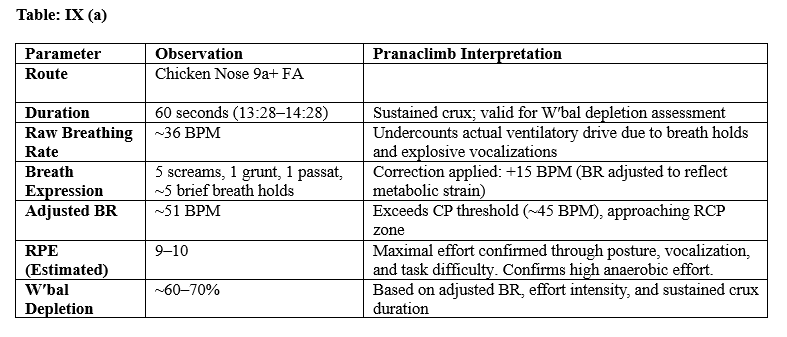
Adam Ondra’s ascent of Chicken Nose (13:28–14:28) provides a textbook example of apparent BR undercounting during high-intensity effort. Over the 60-second crux, raw breathing rate was ~36 BPM. However, five power screams, one grunt, one passat, and approximately five brief breath holds were observed—each reflecting high ventilatory strain and isometric tension. Applying the Pranaclimb BR correction (+15 BPM) raised the adjusted BR to ~51 BPM, placing him above CP and nearing RCP. The estimated RPE was 9–10, confirming a maximal anaerobic effort. W′bal depletion was ~60–70%, consistent with a prolonged crux well into the severe intensity domain. This illustrates the need for expressive-breathing correction in overhanging sequences with explosive or inverted movement.
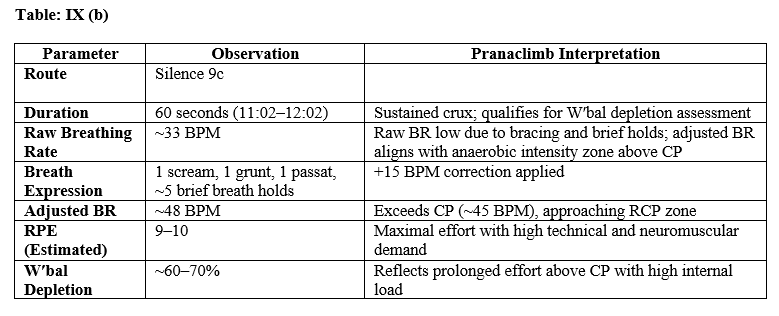
In the historic ascent of Silence (11:02–12:02), Ondra demonstrated similar breath suppression dynamics. The 60-second crux showed a raw BR of ~33 BPM, despite visible strain. Analysis revealed one scream, one grunt, one passat, and ~5 brief breath holds—warranting a +15 BPM correction. The adjusted BR of ~48 BPM indicates a clear breach of CP (~45 BPM), closely approaching RCP. RPE was estimated at 9–10, consistent with the intense neuromuscular and psychological demands of the route. W′bal depletion was again ~60–70%. The example reinforces the reliability of Pranaclimb’s correction framework when high performance masks ventilatory effort through bracing and explosive exhalations.
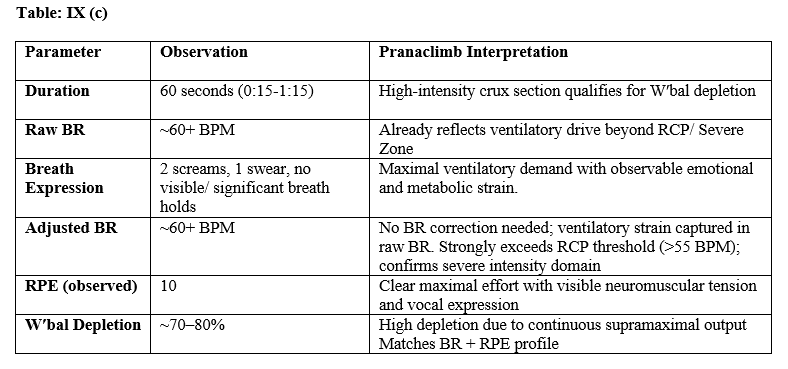
Freja Shannon’s crux sequence on Sista Bossen (0:15–1:15) offers a clear example of sustained effort well into the severe domain. Her raw breathing rate remained consistently above 60 BPM for the entire 60 seconds, with two screams and one audible swear reflecting intense ventilatory and emotional load. RPE was observed at a full 10. Given the already elevated BR, no adjustment was necessary—her ventilatory drive was fully captured in the raw data. This profile places her clearly beyond the RCP threshold, with W′bal depletion estimated at 70–80%. The case exemplifies how high BR and expressive breathing under duress reliably indicate anaerobic load and metabolic fatigue in real-time conditions.
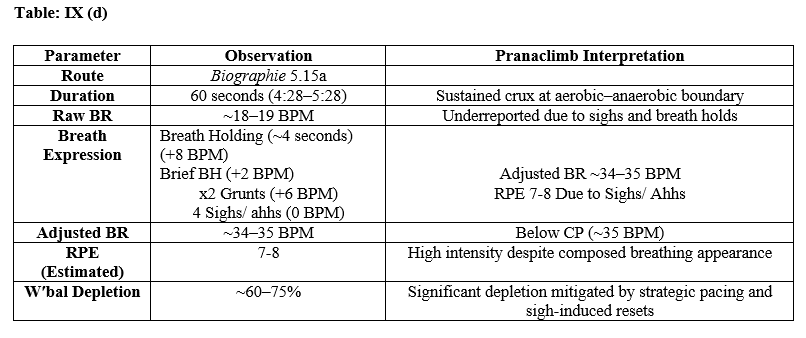
During Margo Hayes’ crux sequence on Biographie, the raw breathing rate was recorded at approximately 19 BPM. However, this deceptively low value reflects significant underreporting due to expressive breathing acts that compress ventilatory effort. Closer analysis identified a 3–4 second breath hold at the start, 2 forceful grunts and a sigh during high-tension moves, a brief grunt, and 3 audible sighs ("ahhs") near the end. Applying Pranaclimb’s BR adjustment logic—+8 BPM for breath holding, +2 BPM for a brief BH, +6 BPM for grunts, and 0 BPM for sighs—the total correction amounted to ~+16 BPM, yielding an adjusted breathing rate of ~34–35 BPM. Although this adjusted BR remains below the established Critical Power threshold (~45 BPM), the elevated Rate of Perceived Exertion (7-8) and the presence of breath holding and sighing suggest that Margo’s metabolic intensity was likely near CP, with breath control strategies compressing ventilatory frequency despite high physiological effort. This example highlights the need to incorporate duration-based breath hold adjustments in the Pranaclimb methodology to accurately estimate workload in climbing scenarios where expressive breathing significantly masks true ventilatory demand.
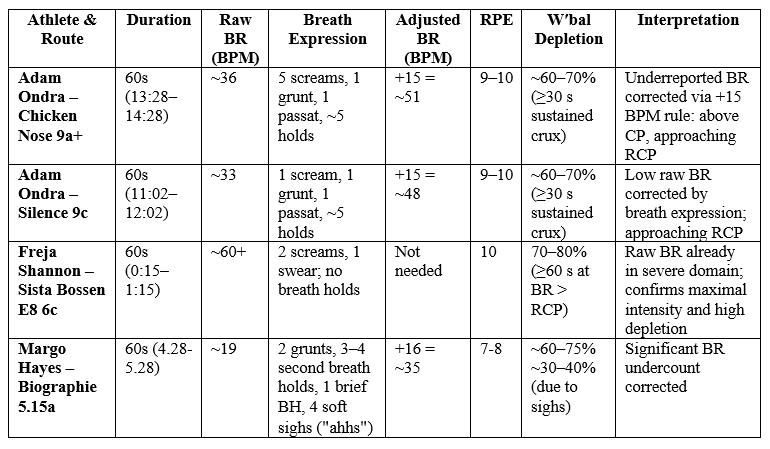
Note: These examples illustrate Pranaclimb’s capacity to detect RCP and W′bal dynamics in real-world conditions through non-invasive breathing analysis and perceived effort.
These case studies highlight how vocalized breathing functions as a legitimate physiological amplifier, elevating oxygen uptake and respiratory drive under maximal load. This supports the inclusion of +5 BPM adjustments for screams and +3 BPM for grunts or sharp exhales, reflecting their true metabolic cost during climbing. It also reinforces the model’s effort to distinguish between passive breath holds and active, high-effort vocalizations.
BritRock Films
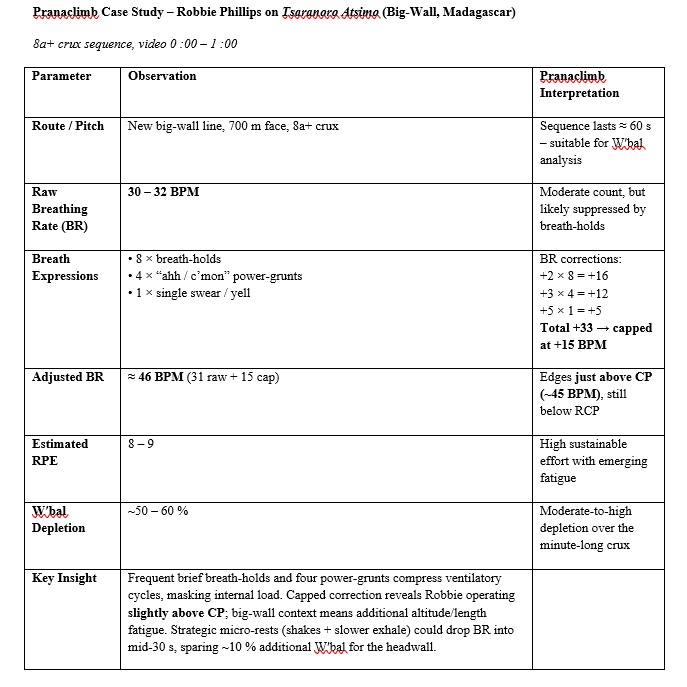
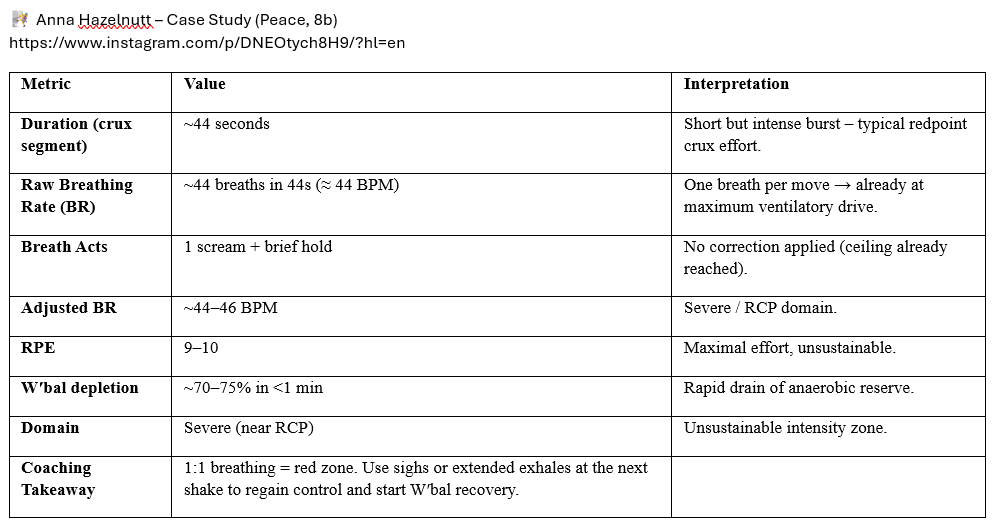
Jimmy Webb – First Ascent (2019, V16 / 8C+)
This is gold for showing how expressive breathing, holds, and power exhales line up with Pranaclimb’s adjustment rules.
Duration: 44s (5:26–6:12 in video)
Terrain: steep overhang
Observed breathing: long BHs, nasal inhale, power exhale, scream
Adjusted BR: ~55–60 BPM (RCP zone)
Estimated W′bal depletion: ~85–95%
Breath timeline (key moments):
Early BH (9s) → tension bracing, +8 BPM adjustment
Strong nasal inhale before dyno → RP Sync prime
Exhale at crux catch → textbook RP Sync release
Scream + BH → +10 BPM, accelerates depletion
Relief sigh + YESSS / WOOO → emotional parasympathetic reset
Tim Emmett’s ~7 screams in 60 seconds on Era Vella isn’t just emotional intensity — it’s a physiological case study in how expressive exhalations affect respiratory load, W′bal depletion, and diaphragmatic fatigue.
“Yelling gives power; breathing restores control.”
🫁 Pranaclimb Interpretation
Each scream functions as an expressive exhale — a short, high-pressure burst through partial glottal closure. Tim’s attempt reveals how scream density masks true respiratory cost. With ~7 screams in under a minute, his adjusted BR and W′bal confirm RCP intensity — validating Pranaclimb’s
Scream-Density Override rule as a key diagnostic for expressive, high-intensity climbing.
Stacked screams, grunts, and long breath holds create high intrathoracic pressure, rapid CO₂ accumulation, and diaphragmatic strain. These effects push the climber into the Respiratory Compensation Point (RCP) even when raw BR appears low.
🔹 Application Rule
Trigger the Override when:
7 or more screams occur within 60 s OR
Total time spent screaming + holding breath ≥ 15 s (≈25% of the window)
___________________________________
🔬 Physiological Cost
Intra-thoracic pressure surges with each scream → high tension on diaphragm and intercostals
Reduced tidal volume → less O₂ exchange despite heavy exhale force
W′bal depletion acceleration → estimated 80–95% depletion across the crux
Diaphragm and intercostal strain risk → repeated screaming elevates intrathoracic pressure and strains the diaphragm and intercostals — potentially causing rib flare or displacement (as seen in Tim's case).

Definition:
Expressive Load is the cumulative physiological cost of non-rhythmic breath acts — screams, grunts, sighs, and holds — that alter CO₂/O₂ exchange and neural activation.
Coaching Application:
Use it to understand how expressive breathing shifts a climber’s effort into higher intensity zones even when BR looks low.
Manage through sighs, nasal resets, and CO₂-tolerance training.
Expressive breathing (screams, grunts) adds measurable metabolic cost — treat it like power output.
Screams are powerful but costly.
Budget screams and grunts to sustain power while minimising diaphragmatic fatigue.
Use breath holds tactically — not continuously.
Train resilience in rhythmic breathing under fatigue.
Train expressive efficiency to sustain power without overloading the respiratory system.
Encourage active recovery sighs and nasal recovery breaths during micro-reststo restore oxygen balance.
Exhale on execution — RP Sync maximises precision.
Train diaphragmatic strength and control to prevent rib or intercostal stress under high tension.
Why it fits the Pranaclimb Methodology:
🫁 Breathwork
❄ Cold immersion
🧠 Mindfulness
📈 Long-term pacing
🔥 Emotional expression
🧗 Route-specific strength
🧊 Composure under stress
⏳ W′bal management over 45m pitch
He demonstrated the philosophy:
Turn every dial to 10 — strength, breath, mind, recovery, belief.