Climbing performance is limited as much by breathing as by strength. The Pranaclimb Methodology combines breathing physiology, breathwork training, and field-based performance metrics to help climbers improve endurance, pacing, and recovery on the wall. By tracking breathing rate, perceived exertion, and heart-rate recovery in real time, you can understand exactly how hard you’re working — and learn to climb longer, calmer, and stronger.
Pranaclimb is a field-based, non-invasive system that helps climbers understand effort, pacing, and recovery in real time through breathing. It’s built for climbing’s intermittent efforts (anaerobic bursts, aerobic endurance, and quick recovery) — dynamic movement, expressive breathing, postural constraints, and micro-rests. Access the full research paper at SportRxiv or Research Gate
Anderson, A. (2025). The Pranaclimb Methodology: Non-Invasive Tracking of Critical Power and W′bal Modelling in Rock Climbing Using Breathing Rate, RPE, and HRR. SportRxiv. DOI: https://doi.org/10.51224/SRXIV.578
The Three Core Variables
🫁 Breathing Rate (BR) – real-time effort
🎯 RPE (CR-10) – perceived load (tightly correlated with BR)
❤️ HRR₆₀ – recovery speed
Together they estimate:
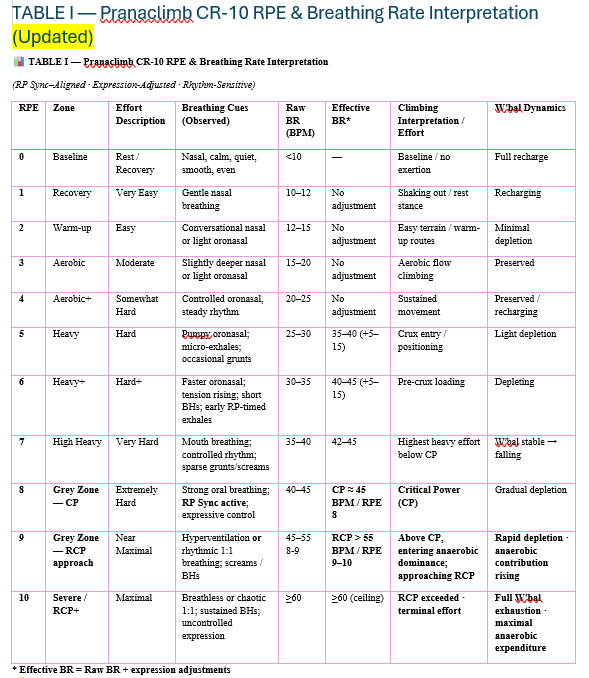
⛰️ CP (~45 BPM / RPE 8)
🔥 RCP (>55 BPM / RPE 9–10)
⚡ W′bal (anaerobic reserve)
W′bal is your “power battery.” When your Effective BR rises above CP (~45 BPM), you’re spending that battery; the higher above CP you go (especially into the Grey Zone and beyond RCP), the faster it drains. When your BRₑ drops below CP (shake-outs, kneebars, good rests), the battery recharges — and it recharges much faster when you truly downshift your breathing (and faster still if HRR₆₀ is strong).
Core RBA – 4-Minute Protocol (with 60 s Crux Focus)
Ideal for field use (projecting), coaching sessions, or post-climb reviews.
Climbers perform a 4-minute maximal-effort climb with a focused 1-minute crux segment while Breathing Rate (BR) is tracked via microphone or smartphone audio (PRANACLIMB APP).
Critical Power (CP) is identified near BR ~45 BPM, RPE 8, and the Respiratory Compensation Point (RCP) near BR >55 BPM, RPE 10, reflecting the physiological transition from steady-state to unsustainable intensity.
Format: 4 minutes maximal-effort climb + 1-minute recovery
2 mins calm nasal baseline
1 min passive recovery → record HRR₆₀ + BR return ≤30 BPM
REST for longer. Work on your ability to find rest points. Breathe rhythmically, slowly, and deeply to recover
One of the greatest distinctions between elite and recreational climbers is not raw power, but rather their recovery strategies. Advanced climbers rest longer, breathe better, and actively manage fatigue during climbs.
🧗 Coaches seeking real-time on-the-wall diagnostics 🧠 Climbers of all levels aiming to connect breath with performance 🌬 Breathwork practitioners integrating physiology into sport 🔬 Researchers exploring field-based respiratory energetics⚡Athletes in other intermittent or tactical sports
Pranaclimb offers a science-backed, highly personalized breathing-coaching experience unlike anything else in the climbing space.
FAQ section
The Pranaclimb Methodology – Q&A